Austenitic stainless steel has high strength and good toughness. The strength of austenitic stainless steel comes from solid solution strengthening of substitutional alloying elements and interstitial nitrogen and carbon. Austenitic stainless steels cannot be hardened or strengthened by heat treatment, and if increased strength is required, it can only be achieved by cold working. Austenitic stainless steel has a high work hardening coefficient and a high work hardening rate, so cold working can greatly increase its strength. Austenitic stainless steels have good formability and can absorb a lot of energy before breaking. This type of stainless steel has good mechanical properties at low and high temperatures.
[KEY WORDS] Mechanical Properties, Physical Properties, Heat Treatment, Solution Annealing, Cold Working.
1. Strength
Table 1 summarizes the room temperature mechanical properties of standard austenitic and high-performance austenitic stainless steels. Compared with 300 series standard austenitic stainless steels, 200 series and high performance austenitic stainless steels have higher yield strength and tensile strength, which is largely due to the solid solution strengthening effect of nitrogen and carbon, It is also directly related to the high degree of alloying of substitutional elements such as molybdenum, nickel and chromium.
Table 1 - Minimum Limits for Mechanical Properties of Standard 300 Series and 200 Series Austenitic Stainless Steels and High Performance Austenitic Stainless Steels
|
GRADE |
UNS NO. |
EN NO. |
Yield Strength 0.2% |
Tensile Strength |
Elongation (2”) |
Maximum Hardness |
|||
|
|
|
|
MPa |
ksi |
MPa |
ksi |
% |
HB |
HRB |
|
Standard Austenitic Stainless Steel - 300 Series |
|||||||||
|
304 |
S30400 |
1.4301 |
205 |
30 |
515 |
75 |
40 |
201 |
92 |
|
304L |
S30403 |
1.4307 |
170 |
25 |
485 |
70 |
40 |
201 |
92 |
|
321 |
S32100 |
1.4541 |
205 |
30 |
515 |
75 |
40 |
217 |
95 |
|
347 |
S34700 |
1.4550 |
205 |
30 |
515 |
75 |
40 |
201 |
92 |
|
316L |
S31603 |
1.4404 |
170 |
25 |
485 |
70 |
40 |
217 |
95 |
|
317L |
S31703 |
1.4438 |
205 |
30 |
515 |
75 |
40 |
217 |
95 |
|
Standard Austenitic Stainless Steel - 200 Series |
|||||||||
|
|
|
|
|
|
|
|
|
|
|
|
201 |
S20100 |
1.4372 |
260 |
38 |
515 |
75 |
40 |
217 |
95 |
|
201L |
S20103 |
- |
260 |
38 |
655 |
95 |
40 |
217 |
95 |
|
201LN |
S20153 |
- |
310 |
45 |
655 |
95 |
45 |
241 |
100 |
|
High Performance Austenitic Stainless Steel |
|||||||||
|
Alloy 20 |
N08020 |
2.4660 |
240 |
35 |
550 |
80 |
30 |
217 |
95 |
|
317LM |
S31725 |
- |
205 |
30 |
515 |
75 |
40 |
217 |
95 |
|
317LMN |
S31726 |
1.4439 |
240 |
35 |
550 |
80 |
40 |
223 |
96 |
|
904L |
N08904 |
1.4539 |
220 |
31 |
490 |
71 |
35 |
- |
90 |
|
- |
S31727 |
- |
245 |
36 |
550 |
80 |
35 |
217 |
- |
|
- |
N08028 |
1.4563 |
500 |
73 |
214 |
31 |
40 |
- |
90 |
|
- |
S34565 |
1.4565 |
415 |
60 |
795 |
115 |
35 |
241 |
100 |
|
- |
N08026 |
- |
241 |
35 |
551 |
80 |
30 |
217 |
95 |
|
- |
S32053 |
- |
295 |
43 |
640 |
93 |
40 |
217 |
96 |
|
- |
N08926 |
1.4529 |
295 |
43 |
650 |
94 |
35 |
- |
- |
|
- |
S31254 |
1.4547 |
310 |
45 |
655 |
95 |
35 |
223 |
96 |
|
- |
N08367 |
- |
310 |
45 |
655 |
95 |
30 |
241 |
- |
|
- |
S31266 |
1.4659 |
420 |
61 |
750 |
109 |
35 |
- |
- |
|
- |
S31277 |
|
360 |
52 |
770 |
112 |
40 |
- |
- |
|
- |
N08031 |
1.4562 |
276 |
40 |
650 |
94 |
40 |
- |
- |
|
- |
N08354 |
|
295 |
43 |
640 |
93 |
40 |
217 |
96 |
|
- |
N08935 |
- |
425 |
62 |
750 |
109 |
35 |
- |
- |
|
- |
S32654 |
1.4652 |
430 |
62 |
750 |
109 |
40 |
250 |
- |
Figure 1 illustrates how nitrogen alloying increases the strength of these steels. For example, when the nitrogen content was increased from the conventional 0.05% to 0.20%, the yield strength increased from 270Mpa to 340Mpa. This has a large effect on the minimum limit for strength in the material specification. For example, ASTM A240 requires a minimum yield strength of 170Mpa for 304L (about 0.05%N) and 240Mpa for 304N (0.15%N). High-performance austenitic stainless steels have higher strengths, such as S31254 (0.20%N) with a minimum yield strength of 310Mpa and S31266 (0.50%N) with a minimum yield strength of 420Mpa.
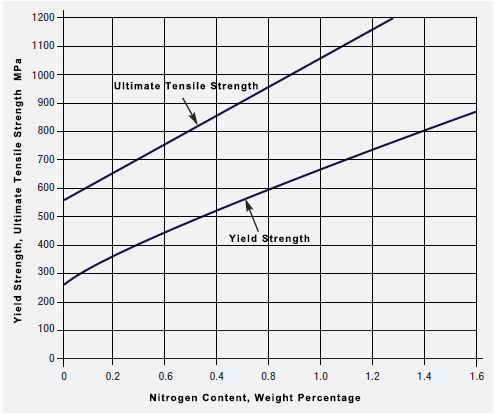
Figure 1 - Effect of Nitrogen On the Strength of Austenitic Stainless Steel
Because austenitic stainless steels cannot be hardened by heat treatment, solution annealing is the usual treatment. If higher strength is required, cold rolled products are available from some mills. Cold working processes such as forming, spinning, swaging, and cold drawing can greatly increase the strength. The high work hardening rate will increase the difficulty of some forming operations, and the section size of the workpiece should meet the power requirements of the equipment. It is sometimes necessary to soften the stainless steel by intermediate annealing before further forming. If the cutting tool causes the workpiece surface to harden, the high rate of work hardening can cause machining problems. Therefore, when machining austenitic stainless steel, it is recommended to slow down the cutting speed and increase the depth of cut. The effect of cold working on the strength of 300 series, 200 series and high performance austenitic stainless steels is shown in Figure 2.
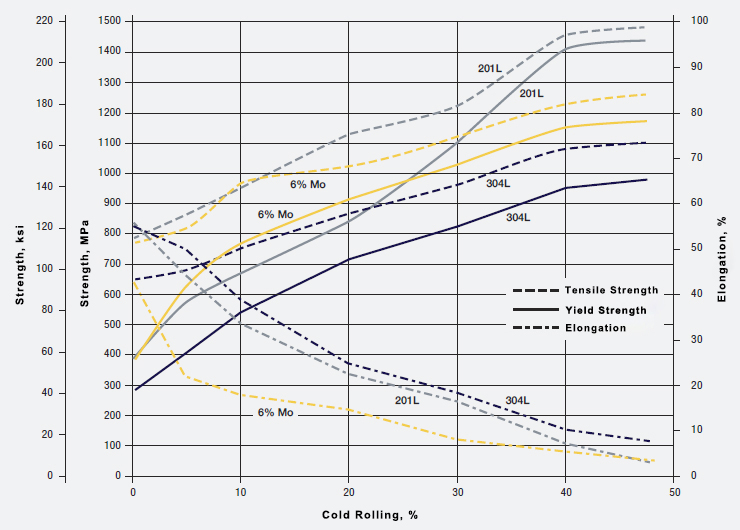
Figure 2 - Effect of Cold Working On Strength and Ductility of 201L, 304L and 6%Mo High Performance Austenitic Stainless Steel NO8367
The strength increased by cold working can only be maintained at moderate temperatures and cannot be sustained at high temperatures. Therefore, cold-worked materials cannot continue to maintain their original strength after annealing or welding.
2. Ductility and Toughness
Austenitic stainless steel has good ductility, and its elongation is between 60% and 70%, which is much higher than the specified minimum limit. Some alloys increase strength by adding nitrogen, which does not reduce ductility. The face-centered cubic crystal structure of the austenite phase provides good ductility and, therefore, very good toughness at ambient and subambient temperatures. Austenitic stainless steels differ from carbon steels and other materials in that they do not exhibit significant ductile-brittle transitions in low temperature environments and can be used in low temperature environments. While cold working reduces ductility and toughness, ductility reduction requires a slow process, so an austenitic stainless steel with 20% cold working will still have 15% or more elongation (Figure 2). Cold working increases the dislocation density of the annealed material and reduces ductility. Annealing removes the effects of cold working through recovery and recrystallization, reducing strength and restoring ductility and toughness to high levels.
3. High Temperature Strength
Austenitic stainless steel has good high temperature strength. Most standard austenitic stainless steels are approved for use in pressure vessels. The ASME (American Society of Mechanical Engineers) pressure vessel code gives allowable design values for temperatures up to 427°C. In furnace applications where pressure is not a concern, standard and some special heat resistant stainless steels are available for 1100°C. High-performance austenitic stainless steels are mainly used in corrosion-resistant environments, and their strength advantages over standard grades at room temperature remain unchanged in high-temperature environments. For example, the ASME specification stipulates that when the temperature is 427°C, the allowable stress of high-performance austenitic stainless steel N08367 is 124MPa, and that of 316 stainless steel is 66MPa. Figure 3 is a comparison of the high temperature strength parameters of 316 stainless steel and three high performance austenitic stainless steels.
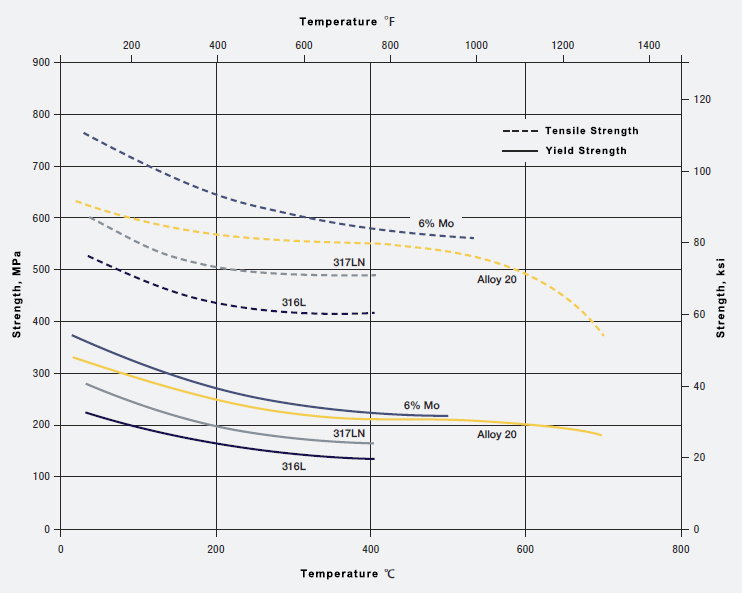
Figure 3 - High Temperature Strength Comparison of Three High Performance Austenitic Stainless Steels (Alloy20, 317LN and UNS NO8367) and 316L Stainless Steel
In addition to good high temperature strength, austenitic stainless steels have the advantage that they do not form α' embrittlement phases like ferritic and duplex stainless steels do when the temperature is above 300°C. However, high-performance austenitic stainless steels will form χ and σ embrittlement phases between 500°C and 1050°C.
Good high temperature strength can have both positive and negative effects on fabrication. The high strength prevents the workpiece from deforming under gravity when the finished workpiece is annealed. However, if the workpiece is deformed, such as during welding, the high strength can make it more difficult to straighten the workpiece. As mentioned earlier, high-strength alloys may exceed the processing capacity of existing forming equipment, so the cross-sectional size is limited by the forming equipment.
4. Physical Properties
The physical properties of austenitic stainless steel are basically the same. Compared to carbon steels, they have a slightly lower Young's modulus (Tensile Modulus), higher coefficient of thermal expansion (CTE), and poorer thermal conductivity. Tables 2 and 3 summarize the detailed parameters of the physical properties of austenitic stainless steels.
Table 2 - Room Temperature Physical Properties of Standard Austenitic and High Performance Austenitic Stainless Steels
|
GRADE |
UNS NO. |
Density |
Specific Heat |
Resistivity |
Young's Modulus |
||||
|
|
|
g/cm3 |
lb/in3 |
J/kg-K |
Btu/lb/°F |
Q-mm2/m |
micro Q in |
GPa |
106 psi |
|
300 SERIES |
|||||||||
|
304L |
S30403 |
8.03 |
0.290 |
500 |
0.120 |
0.72 |
28.3 |
193 |
28.0 |
|
321 |
S32100 |
7.89 |
0.285 |
500 |
0.120 |
0.72 |
28.3 |
193 |
28.0 |
|
347 |
S34700 |
7.97 |
0.288 |
500 |
0.120 |
0.73 |
28.7 |
200 |
29.0 |
|
316L |
S31603 |
7.95 |
0.287 |
469 |
0.112 |
0.74 |
29.1 |
193 |
28.0 |
|
317L |
S31703 |
7.95 |
0.287 |
460 |
0.110 |
0.79 |
31.1 |
200 |
29.0 |
|
200 SERIES |
|||||||||
|
201 |
S20100 |
7.86 |
0.284 |
502 |
0.120 |
0.67 |
26.4 |
207 |
30.0 |
|
High Performance Austenitic Stainless Steel |
|||||||||
|
Alloy 20 |
N08020 |
8.08 |
0.292 |
502 |
0.120 |
1.08 |
42.5 |
193 |
28.0 |
|
Alloy 825* |
N08825 |
8.14 |
0.294 |
440 |
0.015 |
1.13 |
44.5 |
193 |
28.0 |
|
317LM |
S31725 |
7.95 |
0.287 |
460 |
0.110 |
0.79 |
31.1 |
200 |
29.0 |
|
317LMN |
S31726 |
8.02 |
0.290 |
502 |
0.112 |
0.85 |
33.5 |
200 |
29.0 |
|
904L |
N08904 |
7.95 |
0.287 |
461 |
0.110 |
0.95 |
37.4 |
190 |
28.0 |
|
- |
S31727 |
8.02 |
0.290 |
460 |
0.109 |
0.86 |
33.9 |
203 |
29.4 |
|
- |
N08028 |
8.00 |
0.290 |
460 |
0.109 |
0.99 |
39.0 |
105 |
28.3 |
|
- |
S34565 |
8.00 |
0.290 |
510 |
0.122 |
0.92 |
36.2 |
190 |
28.0 |
|
- |
N08026 |
8.13 |
0.294 |
461 |
0.110 |
1.08 |
42.5 |
186 |
27.0 |
|
- |
S32053 |
8.06 |
0.291 |
460 |
0.109 |
0.93 |
36.6 |
188 |
27.3 |
|
- |
N08926 |
8.15 |
0.294 |
461 |
0.110 |
0.88 |
34.6 |
192 |
27.8 |
|
- |
S31254 |
7.95 |
0.287 |
498 |
0.119 |
0.85 |
33.5 |
200 |
29.0 |
|
- |
N08367 |
8.06 |
0.291 |
461 |
0.110 |
0.89 |
35.0 |
195 |
28.2 |
|
- |
S31266 |
8.20 |
0.297 |
450 |
0.113 |
1.00 |
39.4 |
195 |
28.3 |
|
- |
S31277 |
8.02 |
0.289 |
454 |
0.109 |
1.00 |
39.4 |
191 |
27.7 |
|
- |
N08031 |
8.03 |
0.290 |
440 |
0.105 |
1.00 |
39.4 |
195 |
28.3 |
|
- |
N08354 |
8.16 |
0.295 |
440 |
0.105 |
1.03 |
40.6 |
193 |
28.0 |
|
- |
N08935 |
8.06 |
0.291 |
450 |
0.110 |
1.05 |
41.3 |
192 |
27.8 |
|
- |
S32654 |
8.00 |
0.290 |
510 |
0.122 |
0.78 |
30.7 |
188 |
27.6 |
Table 3 - Physical Properties of Standard and High Performance Austenitic Stainless Steels at Ambient and Elevated Temperatures
|
GRADE |
UNS No. |
20°C (68°F) |
100°C (212°F) |
200°C (392°F) |
300°C (572°F) |
400°C (754°F) |
500°C (932°F) |
|
Young's Modulus,GPa(106psi) |
|||||||
|
201 |
S20100 |
200 (29.0) |
194 (28.1) |
186 (27.0) |
179(26.0) |
172 (24.9) |
165(23.9) |
|
304 |
S30400 |
193 (28.0) |
193 (28.0) |
193 (28.0) |
187(27.1) |
183 (26.5) |
179(26.0) |
|
321 |
S32100 |
193 (28.0) |
193 (28.0) |
193 (28.0) |
188(27.3) |
183 (26.5) |
178(25.8) |
|
316L |
S31603 |
200 (29.0) |
194 (28.1) |
185 (26.8) |
177(25.7) |
169 (24.5) |
160(23.2) |
|
317LMN |
S31726 |
200 (29.0) |
194 (28.1) |
186 (27.0) |
179(26.0) |
171 (24.8) |
163(23.6) |
|
- |
S34565 |
193 (28.0) |
187 (27.1) |
180 (26.1) |
173(25.1) |
165 (23.9) |
157(22.9) |
|
- |
N08926 |
193 (28.0) |
186 (27.0) |
179 (26.0) |
173(25.1) |
168(24.4) |
162(23.6) |
|
- |
S32053 |
188(27.3) |
184 (26.7) |
178 (25.8) |
172 (24.9) |
165 (23.9) |
- |
|
- |
N08367 |
195 (28.3) |
189 (27.4) |
180 (26.1) |
172 (24.9) |
163 (23.6) |
158(23.0) |
|
- |
S31266 |
190 (27.6) |
185 (26.8) |
179 (26.0) |
174(25.2) |
166(24.1) |
158(23.0) |
|
- |
N08354 |
198 (28.7) |
194 (28.1) |
189 (27.4) |
183(26.5) |
177(25.7) |
172(24.9) |
|
- |
N08935 |
192 (27.8) |
187 (27.1) |
180 (26.1) |
174(25.2) |
168(24.4) |
161 (23.4) |
|
- |
S32654 |
189 (27.4) |
184 (26.7) |
177 (25.7) |
170(24.7) |
163 (23.6) |
- |
|
Average Coefficient of Thermal Expansion - Temperature 20°C(68°F) 至T - 10-6/K(10-6/°F) |
|||||||
|
304 |
S30400 |
- |
16.6 (9.20) |
16.9 (9.40) |
17.4 (9.65) |
17.6(9.75) |
18.0 (10.00) |
|
321 |
S32100 |
- |
16.0 (8.89) |
16.5 (9.17) |
17.0(9.44) |
17.5 (9.72) |
18.0 (10.00) |
|
316L |
S31603 |
- |
16.5 (9.17) |
16.9 (9.38) |
17.3(9.61) |
17.6(9.78) |
18.0 (10.00) |
|
201 |
S20100 |
- |
16.6 (9.20) |
|
|
|
|
|
Alloy 20 |
N08020 |
- |
14.9 (8.27) |
15.2 (8.44) |
15.5(8.61) |
15.9(8.83) |
16.1 (8.94) |
|
317LMN |
S31726 |
- |
16.6 (9.22) |
17.2 (9.55) |
17.8(9.89) |
18.5(10.30) |
|
|
904L |
N08904 |
- |
15.3 (8.50) |
15.7 (8.72) |
16.1 (8.94) |
16.5 (9.17) |
16.9 (9.39) |
|
- |
S31727 |
- |
15.9 (8.83) |
16.4 (9.11) |
16.7(9.28) |
17.0(9.44) |
17.2 (9.55) |
|
- |
S34565 |
- |
14.5 (8.00) |
15.5 (8.60) |
16.3(9.00) |
16.8(9.30) |
17.2 (9.50) |
|
- |
N08026 |
- |
14.8 (8.22) |
14.9 (8.29) |
15.3(8.52) |
15.7 (8.73) |
16.0 (8.89) |
|
- |
S32053 |
- |
14.5 (8.00) |
15.0 (8.28) |
15.4 (8.55) |
15.8(8.78) |
|
|
- |
N08926 |
- |
15.0 (8.33) |
15.7 (8.72) |
16.1 (8.94) |
16.4(9.11) |
16.7 (9.28) |
|
- |
S31254 |
- |
16.5 (9.17) |
17.0 (9.44) |
17.5(9.72) |
18.0(10.00) |
18.0 (10.00) |
|
- |
N08367 |
- |
15.3 (8.50) |
15.5 (8.60) |
15.7(8.80) |
16.0 (8.90) |
16.0 (8.90) |
|
- |
S31266 |
- |
15.0 (8.33) |
15.5 (8.61) |
16.0(8.90) |
16.3(9.06) |
16.5(9.17) |
|
- |
N08354 |
- |
14.1 (7.83) |
14.6 (8.11) |
14.8 (8.22) |
15.1 (8.40) |
15.4 (8.55) |
|
- |
N08935* |
- |
14.1 (7.81) |
14.7 (8.15) |
15.1 (8.37) |
15.4(8.56) |
15.7 (8.71) |
|
- |
S32654 |
- |
15.0 (8.33) |
15.4 (8.55) |
15.8 (8.78) |
16.2 (9.00) |
- |