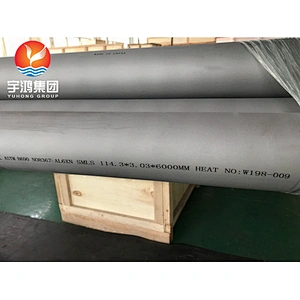
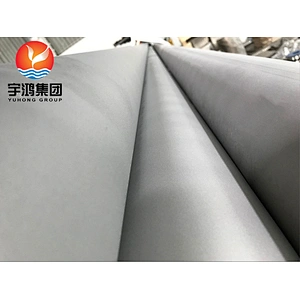
Product Overview
ASTM B690 AL-6XN (UNS N08367) seamless pipe is a nitrogen-strengthened 6-molybdenum super austenitic stainless steel pipe, developed by Allegheny Ludlum (now ATI) in the United States by introducing nitrogen into the AL-6X base. Its original design intent was as a seawater-resistant material. Through a single-phase austenitic formulation of"20%Cr + 24%Ni + 6.5%Mo + 0.22%N,"its Pitting Resistance Equivalent Number (PREN) reaches 45–48, and its chloride stress corrosion cracking resistance approaches nickel-based alloy levels, while retaining the processing advantages of austenitic steel: weldable, cold-formable, and non-magnetic.
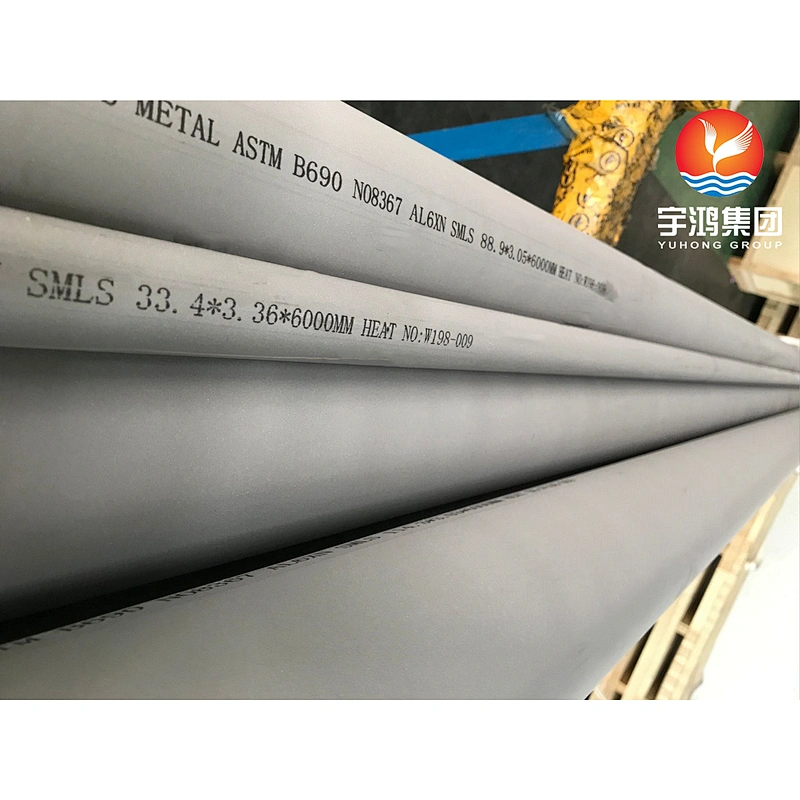
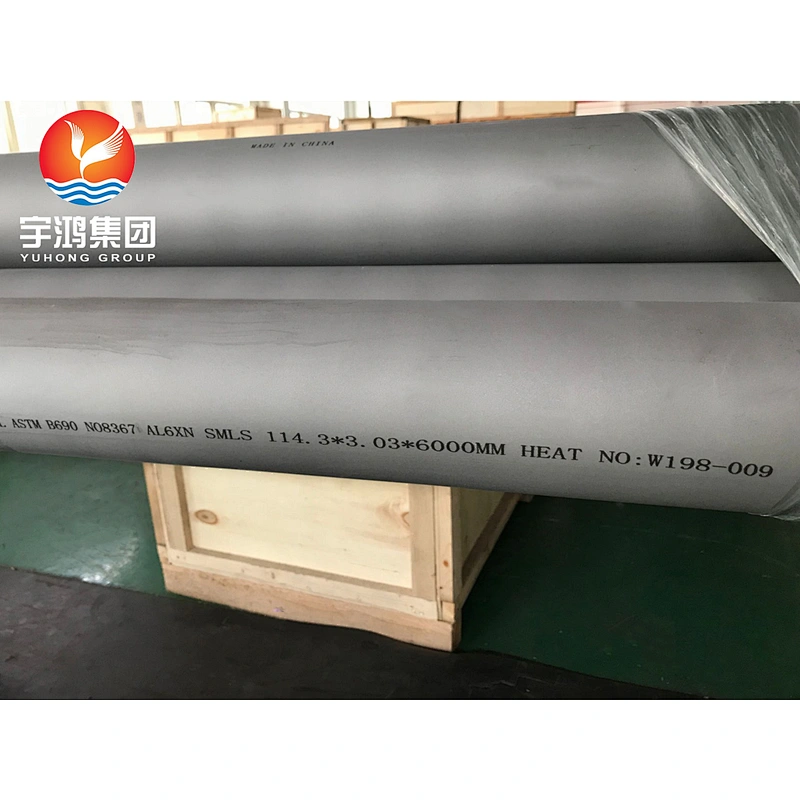
Our AL-6XN seamless pipes are strictly manufactured to ASTM B690 / ASME SB690 standards, delivered in the solution heat-treated + pickled condition, and designed specifically for seawater heat exchangers, flue gas desulfurization, chemical processing, and nuclear power applications in severe corrosive environments.
Core Material Characteristics
Chemical Composition Design
The high-alloy formulation of AL-6XN is the core of its corrosion resistance:
| Element | Content Requirement |
|---|---|
| Carbon (C) | ≤ 0.03% |
| Chromium (Cr) | 20.0 – 22.0% |
| Nickel (Ni) | 23.5 – 25.5% |
| Molybdenum (Mo) | 6.00 – 7.00% |
| Nitrogen (N) | 0.18 – 0.25% |
| Manganese (Mn) | ≤ 2.00% |
| Silicon (Si) | ≤ 1.00% |
| Copper (Cu) | ≤ 0.75% |
| Phosphorus (P) | ≤ 0.040% |
| Sulfur (S) | ≤ 0.030% |
Four key variables define AL-6XN's identity: Molybdenum crosses the 6% threshold to enter the"6Mo super austenitic"club; nickel at around 24% (approximately 6 percentage points higher than 254SMO) significantly reduces chloride stress corrosion cracking susceptibility; nitrogen content of 0.18–0.25% raises yield strength from the ordinary austenitic 200 MPa level to the 310 MPa level while inhibiting sigma phase precipitation; ultra-low carbon (typically 0.02%) ensures no sensitization after welding without stabilization treatment.
Mechanical Properties
| Property | Requirement |
|---|---|
| Tensile Strength | ≥ 655 MPa (wall ≥0.187") / ≥ 670 MPa (wall <0.187") |
| Yield Strength (0.2% offset) | ≥ 310 MPa |
| Elongation | ≥ 30% |
| Density | 8.06 g/cm³ |
| Magnetic Permeability | Near non-magnetic (relative permeability approx. 1.0028) |
AL-6XN's ASME allowable stress values are 40% higher than 316L, nearly twice that of copper-nickel alloys.
Manufacturing and Delivery Condition
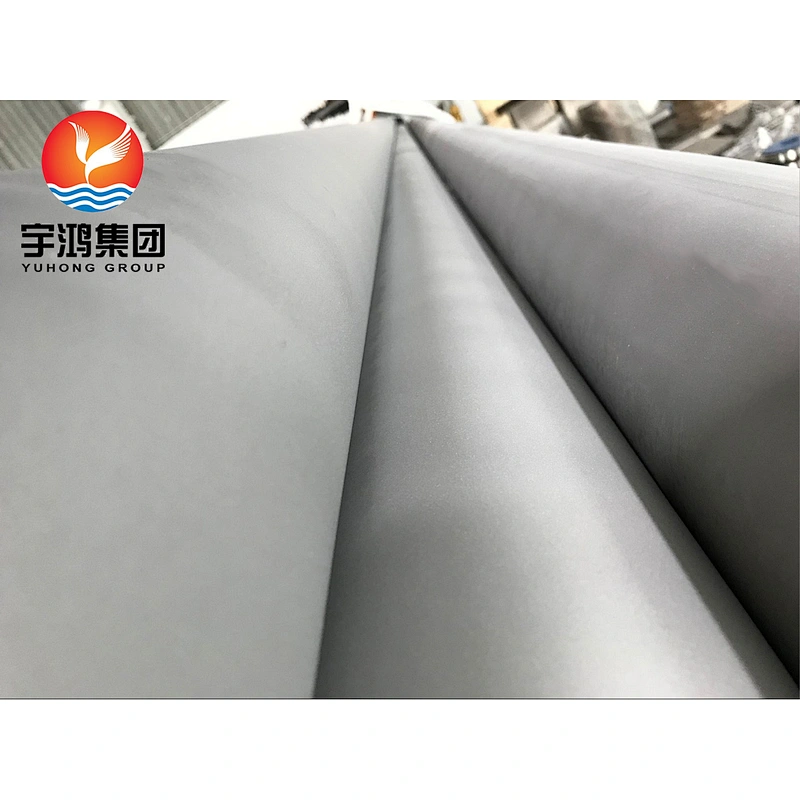
AL-6XN seamless pipes are delivered in the solution heat-treated (1120–1180°C water quenched) + pickled condition, with a single-phase austenitic structure, free of delta ferrite and sigma phase. If bright annealing is used, pickling is not required.
Comparison with 316L, 904L, and Nickel-Based Alloys
Comparison with 316L Stainless Steel
| Comparison Dimension | AL-6XN | 316L |
|---|---|---|
| PREN | 45–48 | Approx. 24 |
| Chloride Pitting/Crevice Corrosion | Excellent | Moderate, prone to pitting |
| Chloride Stress Corrosion Cracking | Excellent (approaching nickel-based) | Susceptible |
| Yield Strength | ≥310 MPa | ≥170 MPa |
| Cost | Medium-High | Low |
Selection Principle: 316L is adequate for general chemical media; for chloride-containing, seawater, or high-concentration halide service, AL-6XN offers clear advantages.
Comparison with 904L
904L is a 4.5%Mo super austenitic stainless steel, forming a gradient positioning with AL-6XN's 6Mo level:
| Comparison Dimension | AL-6XN | 904L |
|---|---|---|
| Molybdenum Content | 6.0–7.0% | 4.0–5.0% |
| PREN | 45–48 | Approx. 34 |
| Pitting/Crevice Corrosion | Step-change improvement | Good |
| Yield Strength | ≥310 MPa | ≥220 MPa |
Selection Principle: 904L is suitable for moderate chloride environments; high-chloride, seawater, or FGD service requires upgrading to AL-6XN.
Comparison with Nickel-Based Alloy C-276
AL-6XN is positioned as an economical alternative to nickel-based alloys:
| Comparison Dimension | AL-6XN | C-276 |
|---|---|---|
| Matrix | Iron-based austenitic | Nickel-based |
| PREN | 45–48 | Approx. 68 |
| Strong Reducing Acids | Good | Irreplaceable |
| Density | 8.06 g/cm³ | 8.89 g/cm³ |
| Cost | Medium-High | High |
Selection Principle: AL-6XN fills the gap between 317L/904L/2205 and C-276, providing corrosion resistance approaching nickel-based alloys in most seawater and chloride applications with significant cost advantages.
Temperature Boundary for Chloride Stress Corrosion Cracking
AL-6XN is not completely immune to all chloride environments. Research shows that its critical temperature for chloride stress corrosion cracking is related to chloride ion concentration:
In chloride environments at atmospheric boiling point (approximately 100°C), AL-6XN is not prone to stress corrosion cracking
When temperature exceeds 120°C, cracking may occur, depending on chloride content
Within the chloride range of 0.02–15.8 wt%, the critical cracking temperature can be estimated by the formula: T_SCC = 190.05 - 47.42 log[Cl]
This boundary is critical for proper selection: low-temperature chloride service offers high AL-6XN reliability; high-temperature, high-chloride service requires evaluation for upgrading to nickel-based alloys.
Typical Application Scenarios
Marine and Seawater Systems: Seawater condenser tube bundles, seawater piping, offshore platform process systems
Flue Gas Desulfurization (FGD): Wet scrubbers, reheater tube bundles, flue liners
Chemical and Petrochemical: Chloride-containing process piping, reactors, heat exchangers
Power Generation and Nuclear: High-pressure feedwater heater tubes, nuclear plant service water piping
Seawater Desalination: Evaporator tube bundles, brine heaters
AL-6XN has proven excellent in high-sulfur coal FGD reheater tube bundles, with chloride pitting and sulfuric acid corrosion resistance meeting the demanding requirements of severe FGD environments.
Common Specification Reference
| Parameter | Common Range |
|---|---|
| Outer Diameter | 6.25 – 203 mm |
| Wall Thickness | 0.5 – 12 mm |
| Length | Max. 15 m or custom cut |
| Delivery Condition | Solution heat treated + pickled |
| Product Form | Seamless pipe, welded pipe, U-bend tube |
We can provide custom U-bend tubes, coiled tubes, and special specifications per customer requirements, with hydrostatic testing, eddy current testing, and third-party witness inspection available.
Welding and Processing Notes
Welding
AL-6XN welding recommends ERNiCrMo-3 filler metal, using GTAW (TIG) or GMAW processes. Due to its non-magnetic, single-phase austenitic characteristics, there is no martensitic transformation risk in the weld heat-affected zone, and post-weld heat treatment is generally not required to maintain corrosion resistance.
Processing
AL-6XN retains the processing characteristics of austenitic stainless steel: cold-formable, weldable, non-magnetic, but with lower thermal conductivity than carbon steel and higher linear expansion coefficient (14.2×10⁻⁶/℃). Heat dissipation and dimensional stability control require attention during processing.
Quality Assurance and Services
Standard Compliance: Strictly manufactured to ASTM B690 / ASME SB690, with EN 10204 3.1 material certificates available
Inspection Certification: Third-party inspection supported including SGS, BV, TUV
Heat Treatment Control: Solution treatment temperature 1120–1180°C, rapid cooling ensuring single-phase austenitic structure
Customization Services: Drawing-based customization of U-bend tubes, coiled tubes, and special specifications
Technical Support: Assistance with confirming AL-6XN applicability based on customer media chloride concentration and temperature conditions
FAQ
Q1: Are AL-6XN, UNS N08367, and DIN 1.4501 the same material?
Yes. AL-6XN is ATI's commercial trade name, UNS N08367 is the American unified numbering system designation, and DIN 1.4501 (Werkstoff Nr.) is the European material number. All three refer to the same nitrogen-strengthened 6Mo super austenitic stainless steel. It is recommended to also specify UNS N08367 in orders for accuracy.
Q2: What is the difference between AL-6XN and 254SMO?
Both are 6Mo super austenitic stainless steels, with the core difference being nickel content: AL-6XN has a nickel content of 23.5–25.5%, approximately 6 percentage points higher than 254SMO (17.5–18.5% Ni). The higher nickel content significantly reduces AL-6XN's chloride stress corrosion cracking susceptibility, which is the most critical engineering difference between the two.
Q3: What is the maximum service temperature of AL-6XN?
AL-6XN has reliable stress corrosion cracking resistance in chloride environments at atmospheric boiling point (approximately 100°C). When temperature exceeds 120°C, cracking risk must be evaluated based on specific chloride concentration. In non-chloride environments, AL-6XN can withstand higher temperatures, but sigma phase precipitation risk requires attention.
Q4: What is the delivery condition of AL-6XN?
AL-6XN seamless pipes are delivered in the solution heat-treated + pickled condition, with a solution treatment temperature of 1120–1180°C followed by water quenching. If bright annealing is used, pickling is not required.
Q5: Can AL-6XN completely replace nickel-based alloy C-276?
It cannot completely replace it. AL-6XN is positioned as an economical alternative to nickel-based alloys, providing corrosion resistance approaching C-276 in most seawater, chloride, and oxidizing acid environments with significant cost advantages. However, in strong reducing acids (such as high-concentration hydrochloric acid) or high-temperature, high-chloride service, C-276 remains irreplaceable.
Q6: Does AL-6XN require heat treatment after welding?
Generally not required. AL-6XN has a single-phase austenitic structure, and its ultra-low carbon design (≤0.03%) inhibits grain boundary carbide precipitation. Post-weld stabilization or solution treatment is not required to maintain corrosion resistance. The recommended filler metal is ERNiCrMo-3.
Q7: Are U-bend tube customization and special specifications supported?
Yes. We can provide seamless pipes with outer diameters from 6.25–203 mm and wall thicknesses from 0.5–12 mm, with drawing-based customization of U-bend tubes, coiled tubes, and special lengths. Bending radius, wall thickness thinning rate, and surface treatment can all be customized per customer requirements.
Q8: What are the delivery lead time and minimum order quantity?
Delivery lead time and minimum order quantity are determined by specifications, quantity, and inspection requirements. Common specifications are available from stock; custom specifications typically require 15–30 working days. Please consult our sales team for details.