
Overview
What is duplex stainless steel pipe?
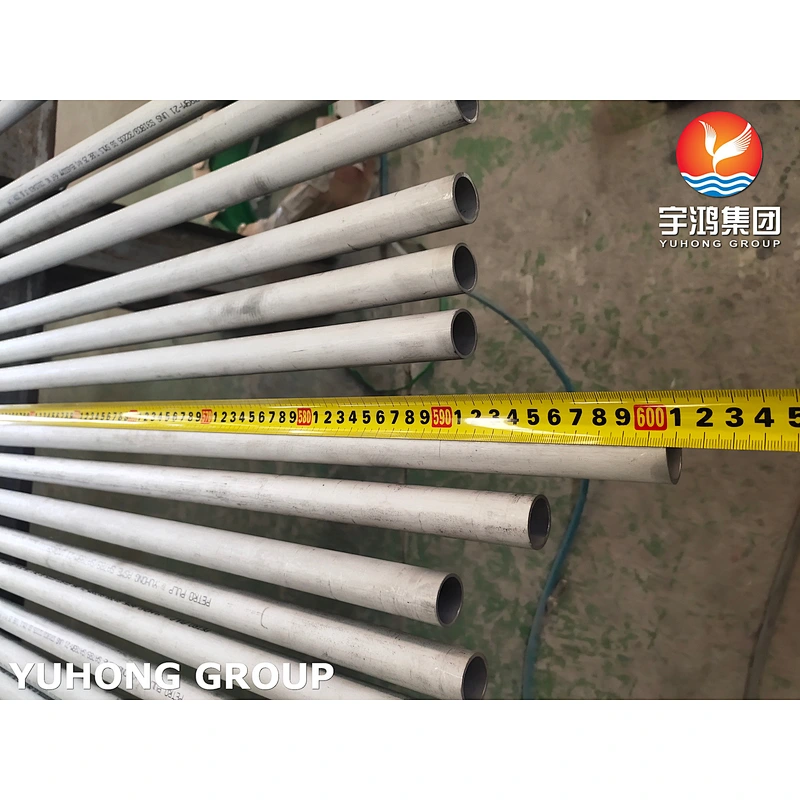
Duplex stainless steel pipe has good welding properties, compared with ferritic stainless steel and austenitic stainless steel, it is neither like the welded heat-affected zone of ferritic stainless steel, due to severe coarsening of the grain and a significant reduction in plastic toughness, nor is it like austenitic stainless steel, which is more sensitive to welding heat cracking. Due to its special advantages, duplex stainless steel is widely used in petrochemical equipment, seawater and wastewater treatment equipment, oil and gas pipelines, paper making machinery and other industrial fields, and in recent years has also been studied for bridge load-bearing structure field, with good prospects for development. Duplex stainless steel is in its solid hardening organization in the ferrite phase and austenite phase each half, the general minimum phase content of perhaps 30%.
Duplex stainless steel pipe continuous use temperature range of -50 ~ 250 ℃, the lower limit depends on the steel brittle transition temperature, the upper limit by 475 ℃ brittle limit, the upper temperature can not exceed 300 ℃. Duplex stainless steel tubes require fast cooling after solid solution treatment, slow cooling can cause the precipitation of brittle phases, which leads to a decrease in the toughness of the steel, especially the resistance to local corrosion.
Specification
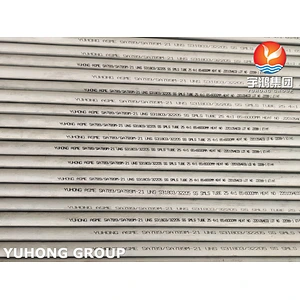
ASTM A789/A789M-22 Standard Specification for Seamless and Welded Ferritic/Austenitic Stainless Steel Tubing for General Service
This specification covers standard requirements for grades of nominal wall thickness, stainless steel tubing for services requiring general corrosion resistance, with particular emphasis on resistance to stress corrosion cracking. These steels are susceptible to embrittlement if used for prolonged periods at elevated temperatures. Heat and product analyses shall be performed wherein the steel shall conform to the required chemical composition for carbon, manganese, phosphorus, sulfur, silicon, nickel, chromium, molybdenum, nitrogen, copper, and others. All tubes shall be furnished in the heat-treated condition in accordance with the specified temperature and quench conditions. When the final heat treatment is in a continuous furnace, or when heat treated condition is obtained directly by quenching after hot forming, the number of tubes of the same size and from the same heat in a lot shall be determined from the prescribed sizes of the tubes. The material shall conform to the prescribed tensile and hardness properties. Mechanical tests such as tension test, flaring test (for seamless tubes), flange test (for welded tubes), hardness test, and reverse flattening test shall be performed on the steel tubing. Each tube shall also be subjected to the nondestructive electric test or the hydrostatic test.
Standard | ASTM A789 | ASTM A790 | EN 10216-5 |
Grade | S31803 S32205 S32750 | S31803 S32205 S32750 | 1.4301 1.4307 1.4948 1.4315 |
Yield Strength | ≥450;≥485;≥550 | ≥450;≥450;≥550 | — |
Tensile Strength | ≥620;≥655;≥800 | ≥620;≥655;≥800 | — |
Elongation | ≥25;≥25;≥15 | ≥25;≥25;≥15 | — |
Hydrostatic Test | The Hydrostatic Test shall be in accordance with ASTM A1016.Could be replaced by ECT. | The Hydrostatic Test shall be in accordance with ASTM A999.Could be replaced by ECT. | The hydrostatic test shall be carried out at a test pressure of 7MPa or |
Intergranular Corrosion | Usually use Pitting Corrosion Test. | Usually use Pitting Corrosion Test. | EN ISO 3651-2 (Optional) |
Eddy Current Test | Could be replaced by HT. | Could be replaced by HT. | EN 10246-3 |
Chemical Composition
UNS | Composition, % | |||||||||
C | Mn | P | S | Si | Ni | Cr | Mo | N | Cu | |
S31803 | 0.03 | 2 | 0.03 | 0.02 | 1 | 4.5-6.5 | 21.0-23.0 | 2.5-3.5 | 0.08-0.20 | . . . |
S32205 | 0.03 | 2 | 0.03 | 0.02 | 1 | 4.5-6.5 | 22-23 | 3.0-3.5 | 0.14-0.20 | . . . |
S31500 | 0.03 | 1.20-2.00 | 0.03 | 0.03 | 1.40-2.0 | 4.3-5.2 | 18-19 | 2.5-3.0 | 0.05-0.10 | . . . |
S32550 | 0.04 | 1.5 | 0.04 | 0.03 | 1 | 4.5-6.5 | 24-27 | 2.9-3.9 | 0.10-0.25 | 1.50-2.50 |
S31200 | 0.03 | 2 | 0.045 | 0.03 | 1 | 5.5-6.5 | 24-26 | 1.-2.0 | 0.14-0.20 | . . . |
S31260 | 0.03 | 1 | 0.03 | 0.03 | 0.75 | 5.5-7.5 | 24-26 | 2.5-3.5 | 0.10-0.30 | 0.20-0.80 |
S32001 | 0.03 | 4.0-6.0 | 0.04 | 0.03 | 1 | 1.0-3.0 | 19.5-21.5 | 0.6 | 0.05-0.17 | 1.00 |
S32304 | 0.03 | 2.5 | 0.04 | 0.04 | 1 | 3.0-5.5 | 21.5-24.5 | 0.05-0.60 | 0.05-0.20 | 0.05-0.60 |
S32750 | 0.03 | 1.2 | 0.035 | 0.02 | 0.8 | 6.0-8.0 | 24-26 | 3.0-5.0 | 0.24-0.32 | 0.50 |
S32760 | 0.05 | 1 | 0.03 | 0.01 | 1 | 6.0-8.0 | 24-26 | 3.0-4.0 | 0.20-0.30 | 0.50-1.00 |
S32950 | 0.03 | 2 | 0.035 | 0.01 | 0.6 | 3.5-5.2 | 26-29 | 1.0-2.5 | 0.15-0.35 | . . . |
S32520 | 0.03 | 1.5 | 0.035 | 0.02 | 0.8 | 5.5-8.0 | 23-25 | 3.0-5.0 | 0.20-0.35 | 0.8 |
Mechanical Properties
Tensile Requirements
Grade | Tensile strength, min, ksi [MPa] | Yield strength, min ksi [MPa] | Elongation in 2 in., or 50mm, min,% | Hardness, Max |
S31803 | 90 [620] | 65 [450] | 25 | 290 |
S32205 | 95 [655] | 70 [485] | 25 | 290 |
S31500 | 92 [630] | 64 [440] | 30 | 290 |
S32550 | 110 [760] | 80 [550] | 15 | 297 |
S31200 | 100 [690] | 65 [450] | 25 | 280 |
S31260 | 100 [690] | 65 [450] | 25 | 290 |
S32001 | 90 [620] | 65 [450] | 25 | 290 |
S32304 | 100 [690] | 65 [450] | 25 | 290 |
S32750 | 116 [800] | 80 [550] | 15 | 310 |
S32760 | 109 [750] | 80 [550] | 25 | 300 |
S32950 | 100 [690] | 70 [480] | 20 | 290 |
S32520 | 112 [770] | 80 [550] | 25 | 310 |
Applications
a) Petroleum
b) Chemical industry
c) Instrument
d) Industrial transportation
e) Mechanical structure industry
f) Need high corrision ability pipe's industry, such as offshore industry etc